
December 19, 2025
- seedfoundation
- Leave a Comment on Public Consultation and Education Policy Reform in Lagos: When Listening Becomes the Work
Public consultation is often treated as a procedural step in education policy reform.
In Lagos State, it became a test of whether the system was prepared to listen, adapt, and learn.
“Consultation is not a checkbox. It is a test of whether a system is ready to learn.”
When the draft Lagos State Non-State Schools Policy entered the public consultation phase in November 2025, expectations were familiar: limited engagement, predictable submissions, and feedback that would ultimately change little.
That is not what happened.
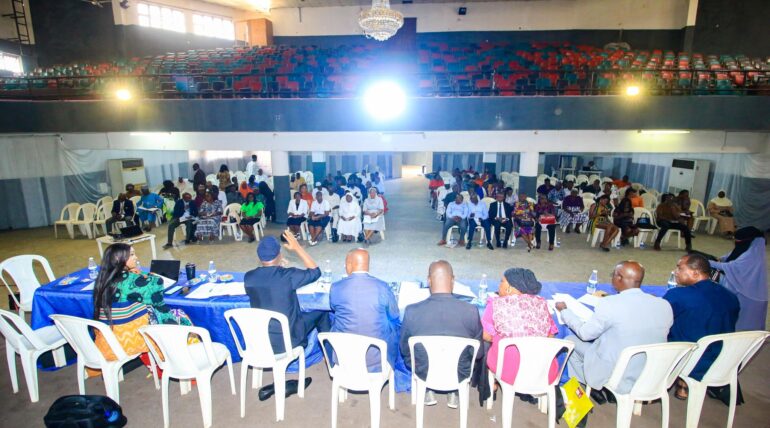
On Tuesday, 25 November 2025, the Committee on the Lagos State Policy on Non-State Schools (LSPNS) held its Public Hearing, where nearly 200 stakeholders came together to interrogate and strengthen the draft policy.
On 2nd December 2025, the deadline for the memoranda submission, nineteen memoranda were formally submitted, reflecting perspectives from school owners, teachers, researchers, international partners, and education advocates. Eleven of these memoranda emerged directly from SEED Care & Support Foundation’s deliberate stakeholder engagement, particularly with groups most affected by the policy, including affordable non-state schools.
This reflection documents what public consultation can achieve when it is treated not as a formality, but as a system learning mechanism.
Mobilising Voices, Not Just Responses
SEED’s approach to public consultation was simple, but intentional:
don’t wait for feedback, go where the voices are.
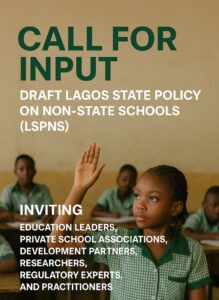
This meant:
- engaging affordable non-state school operators
- holding one-on-one conversations with practitioners
- convening webinars and reflection sessions for stakeholder groups
- amplifying consultation calls through social media
- supporting stakeholders to translate lived experience into policy-relevant memoranda
The goal was not volume for its own sake. It was quality, clarity, and representativeness.
The resulting submissions went beyond objections or endorsements. They surfaced implementation risks, financing realities, trust gaps, and practical considerations that only emerge when those closest to the system are genuinely heard.
What the Public Consultation Process Revealed

Submissions included perspectives from: international education partners, researchers linked to global education evidence, and practitioners with lived experience of Lagos’ education system.
Three themes cut across the memoranda submitted:
Implementation Matters More Than Intention
Stakeholders were less concerned about policy ambition and more focused on how commitments would be executed, sequenced, and sustained.
Financing Is Central to Equity
Feedback consistently highlighted that regulatory expectations without viable financing pathways risk deepening inequality, especially for affordable non-state schools serving low-income communities.
Trust Is Built Through Process
The act of consultation itself, when done sincerely, began to rebuild confidence in reform, even among historically sceptical actors.
Consultation Is Not the End, It Is the Hard Part
Public consultation is often treated as the final step of policy drafting.
In reality, it is where the hardest work begins.
For SEED, this phase marks a transition:
from listening
to synthesising
to advocating for faithful incorporation of public voice.
All nineteen memoranda now require careful review, mapping against policy provisions, clarification where needed, and principled deliberation within the drafting committee. This is essential, not only for technical quality, but for legitimacy.
Because when people offer their voices in good faith, and those voices disappear without explanation, trust is lost.
What This Moment Means for Education Reform in Lagos
As the draft policy moves toward finalisation and onward approval from the Honourable Commissioner, this stage will determine whether the Lagos State Non-State Schools Policy is merely compliant, or genuinely people-centred.
For SEED, the responsibility is clear: to steward this phase with integrity, transparency, and a commitment to learning, ensuring that reform is not only done for the people, but demonstrably shaped by them.
Education reform does not succeed because everyone agrees.
It succeeds when systems learn to listen, adapt, and act, without losing trust along the way.