





July 17, 2026
- seedfoundation
- Leave a Comment on Lagos State Policy on Non-State Schools: Why the Journey Doesn’t End with the Draft
When a policy draft is completed, it is tempting to celebrate the finish line. In reality, it marks the beginning of a different and often more difficult phase of reform.
One of the most important lessons emerging from the development of the Lagos State Policy on Non-State Schools is that meaningful education reform is not defined by the production of a policy document alone. It is defined by the systems, institutions and partnerships that carry that document through review, approval, implementation and continuous improvement.
Over the past year, SEED has documented key milestones in the development of the Lagos State Policy on Non-State Schools: from the technical drafting process to public consultation and stakeholder engagement. This reflection turns to a less visible but arguably the most challenging phase of policy reform: what happens after a policy draft is submitted for approval.
A Different Kind Of Milestone
On 13 March 2026, the Draft Lagos State Policy on Non-State Schools was formally presented to the Honourable Commissioner for Basic and Secondary Education by the Drafting Committee, led by the Director General of the Office of Education Quality Assurance (OEQA), the Chairperson of the Drafting Committee.
For members of the Drafting Committee, the submission marked the successful completion of the committee’s mandate: translating evidence, stakeholder perspectives and technical expertise into a policy framework capable of strengthening Lagos State’s engagement with non-state education providers.
It represented an important institutional milestone, but it did not represent the end of the reform journey. Rather, it marked the beginning of another phase, one that is often less visible but equally important.


Why This Stage Matters
Across many education systems, considerable attention is given to policy development. Far less attention is paid to what happens after a draft is completed.
Yet this stage determines whether months of consultation, technical expertise and stakeholder engagement ultimately translate into institutional change.
Policy reform requires sustained momentum across several stages:
- Technical drafting
- Administrative and political review
- Legal review
- Executive approval
- Institutional implementation
- Monitoring, learning and continuous improvement
Each stage requires leadership, coordination and commitment.
The transition from one stage to the next is where many reforms lose momentum. This is not necessarily because of opposition but because competing priorities, administrative processes and changing political contexts slow progress.
Recognising this reality is not a criticism of government. Rather, it is an acknowledgement that policy reform is a process that requires sustained stewardship.
A National Perspective

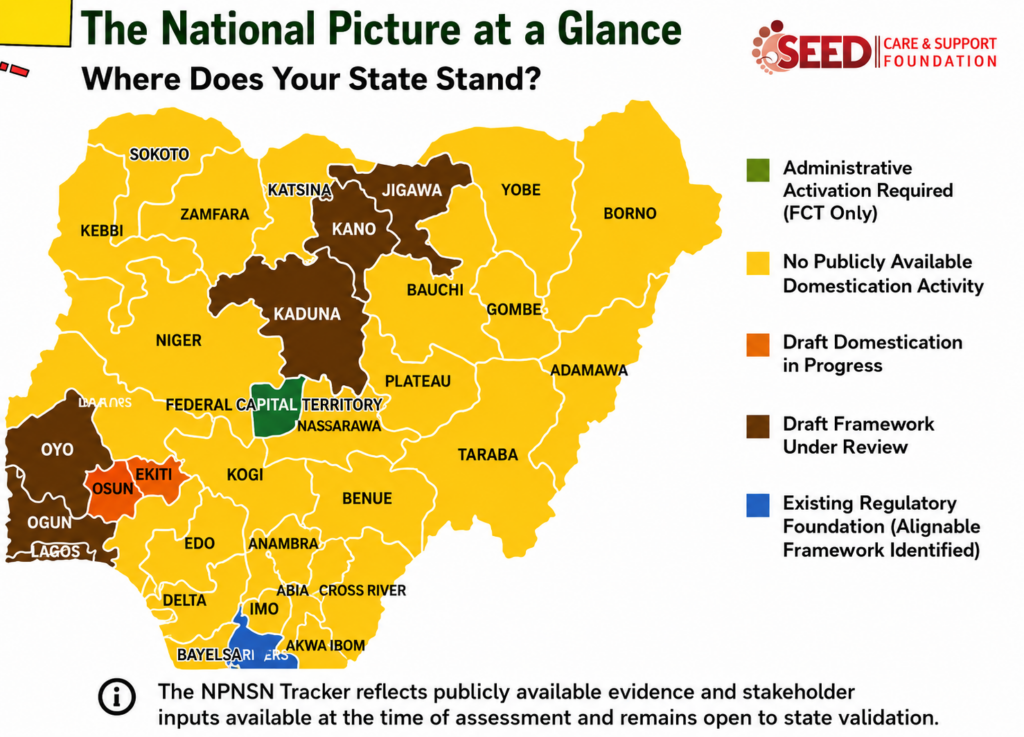
This lesson extends beyond Lagos State. SEED’s NPNSN Tracker, released one year after the launch of Nigeria’s National Policy on Non-State Schools, found that no state had yet completed full domestication of the national policy.
Rather than signalling policy failure, this finding highlights an often-overlooked reality: translating national policy into state-level reform is a complex institutional process that requires sustained leadership, coordination, political commitment and administrative follow-through.
It also reinforces the importance of documenting not only policy outcomes, but the implementation journeys that shape them.
Developing policy is only the beginning.
Sustaining momentum through approval, implementation and learning is where long-term reform is either realised or lost.
Why Documentation Matters

One of the reasons SEED has chosen to document this journey is that policy reform is often remembered only through the final document. The process that shaped it: the evidence, debates, compromises and institutional learning is rarely captured, yet it often contains the lessons that are most valuable to future reforms.
By the time a policy is approved, much of the institutional memory behind how it was developed has already been lost.
The difficult conversations.
The technical debates.
The stakeholder negotiations.
The compromises.
The lessons learned.
Capturing these experiences serves two important purposes.
First, it contributes to transparency and institutional memory within Lagos State.
Second, it creates practical knowledge that other states can adapt as they begin their own domestication journeys.
This is particularly important as more states move from national policy commitments towards locally relevant implementation frameworks.
Looking Ahead
The Lagos State Policy on Non-State Schools represents an important opportunity to strengthen collaboration between government and non-state education providers while improving quality, accountability, inclusion and learner outcomes.
The journey continues.
As the policy proceeds through the remaining stages of review and approval, SEED Care & Support Foundation remains committed to documenting not only milestones but also the lessons that emerge along the way.
Education reform is not measured by the publication of a policy document. It is measured by the extent to which that policy is translated into better institutions, stronger partnerships, improved implementation and, ultimately, better outcomes for learners.
This is the journey we will continue to document, not only to preserve institutional memory, but to contribute practical lessons that can strengthen education policy reform across Lagos State, Nigeria and the wider Global South.
Because when implementation lessons are documented and shared, today’s reforms become tomorrow’s starting points and every policy journey becomes an opportunity for collective learning.
~ Olanrewaju Oniyitan. Executive Director, SEED Care & Support Foundation